Follow the check, then follow the threat
Begin with three objects at a retro game exhibition: an original game, a licensed import, and a homebrew program. Why might one console accept one and reject another?
The answer depends on what the platform checks, what an attacker can reach, and what outcome the designer is trying to prevent. The plates follow that question from Mega Drive through PS1 and PS2, then connect media authorization to—but distinguish it from—Secure Boot.
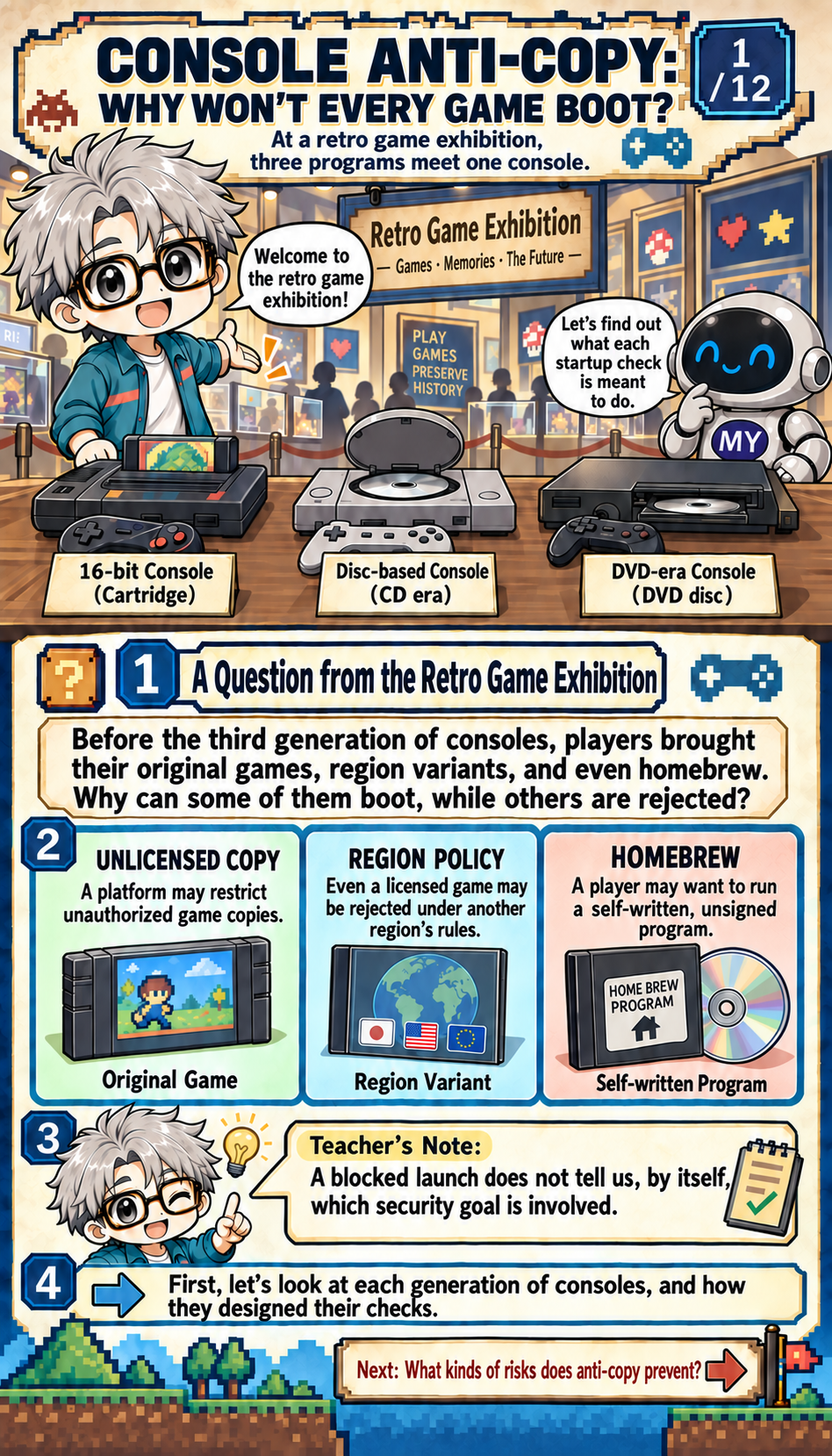
A retro exhibition gives us a question
At a museum table, a visitor sets down three things: an original game, a licensed game from another region, and a small program they wrote themselves. The same console may accept one and refuse another. Before we call that refusal a security success or a flaw, we need to ask what the platform is trying to recognize.
A blocked launch is only an observable symptom. It does not tell us whether the console rejected a copied game, enforced a regional rule, declined an unsigned program, or encountered a compatibility problem. Those cases protect different assets and can affect different people.
This lesson follows three generations of consoles to see what their checks examined and where later work crossed a boundary. We will discuss historical attack categories at a high level, not provide modification, wiring, disc-copying, or exploit instructions. The aim is to understand the design problem, not reproduce a bypass.
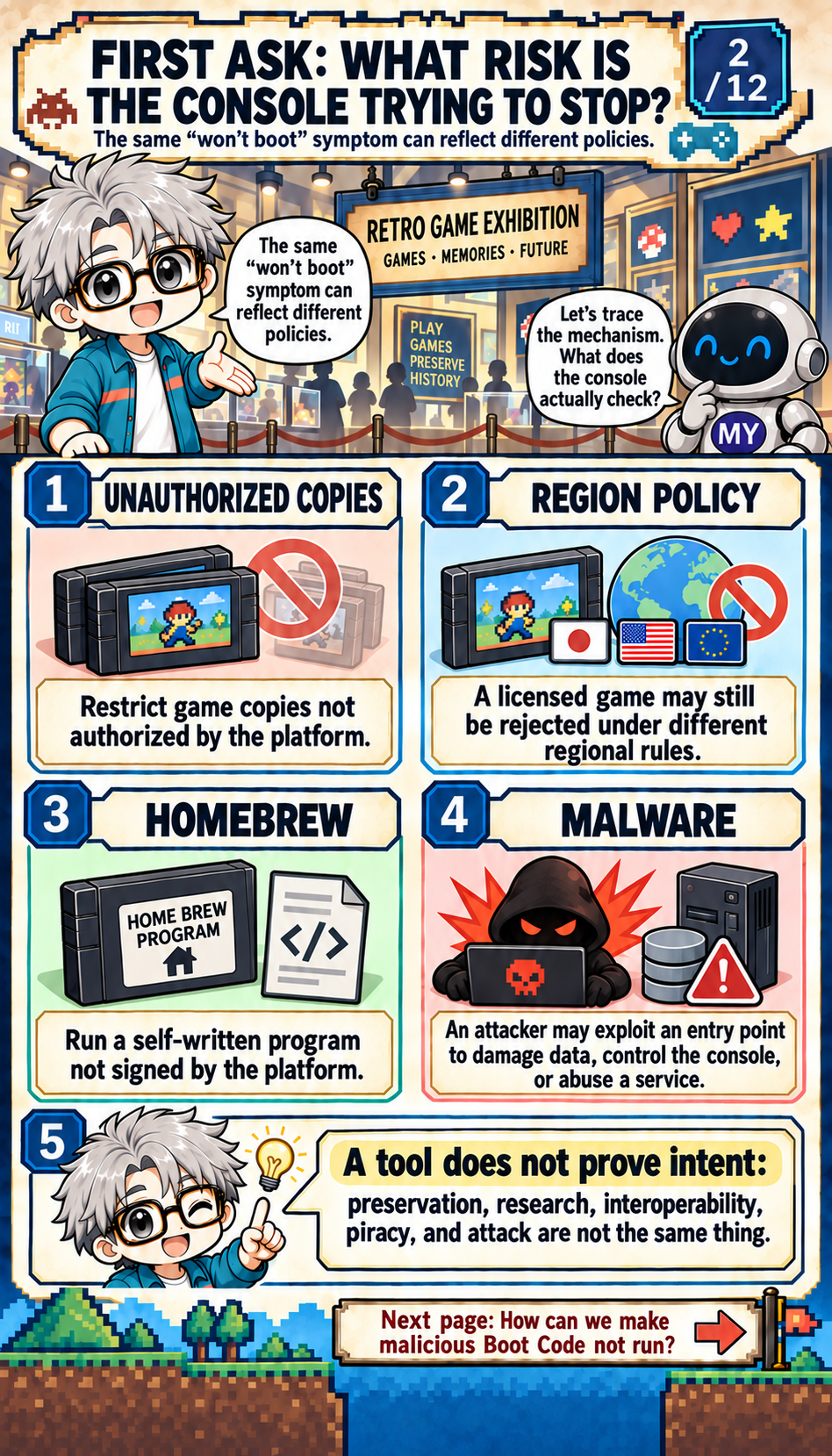
One symptom can hide several threat models
Unauthorized copies can harm a platform holder or game publisher by bypassing licensing. Region rules are different: a perfectly genuine game may be refused because the platform applies a territory policy. A player who writes homebrew may simply want to experiment, preserve a game, or build an accessibility tool. None of those purposes is automatically equivalent to malicious control.
A security engineer starts with assets and capabilities. Is the asset the game publisher's authorization, the console's code integrity, saved data, a player's account, or an online service? Can the attacker only provide a cartridge or disc, or can they also alter hardware, control a network path, or supply malformed input? The answer changes which defense matters.
The impact also matters. An unauthorized copy, a compatibility failure, cheating in a network match, theft of account data, and execution of malware are not interchangeable outcomes. A vulnerability can be useful for one purpose and later be abused for another; the capability alone does not establish a particular user's intent.
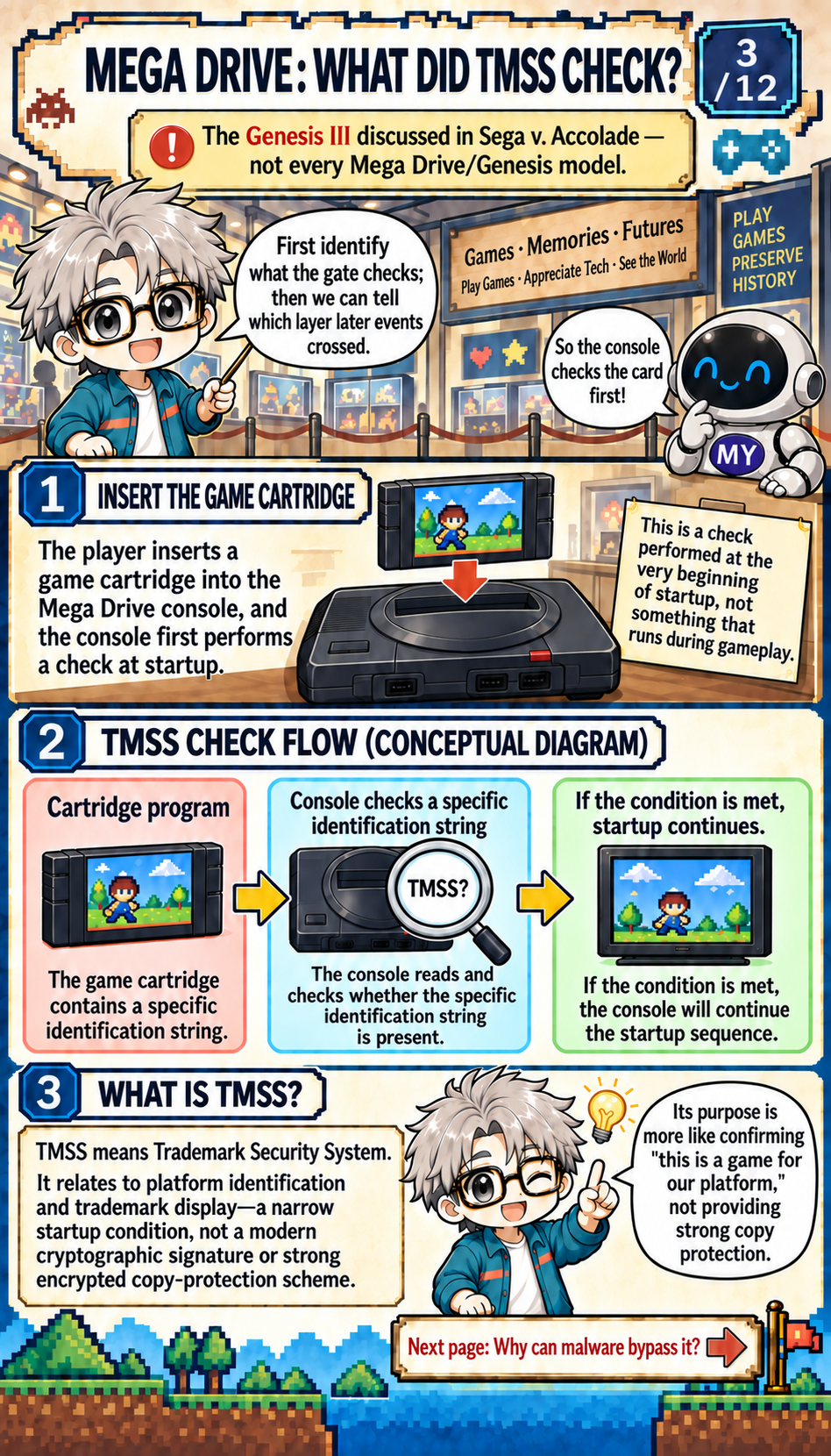
What TMSS checked on the Genesis III in Sega v. Accolade
The Sega v. Accolade opinion discusses the Genesis III, which it describes as the most recent version of the Genesis console at that time. A cartridge contained a particular identification string, and the console's startup behavior depended on that condition. The opinion concerns this console, not every Mega Drive or Genesis model. [1]
A platform-identification gate checks its expected marker. That narrow condition may shape compatibility or display a trademark message without authenticating every byte of a game. Keep the marker and change another program byte: the marker may still match. A signature covering that byte would reject the change. The experiment below uses a custom ACAD marker to compare these checks; it does not implement Genesis III TMSS. [1]
That distinction gives us a useful engineering question: what evidence does a gate actually verify, and what claim does the designer infer from it? If the evidence is only a recognizable marker, the system must not treat it as a cryptographic proof of origin or as broad protection against every way of running a program. [1]
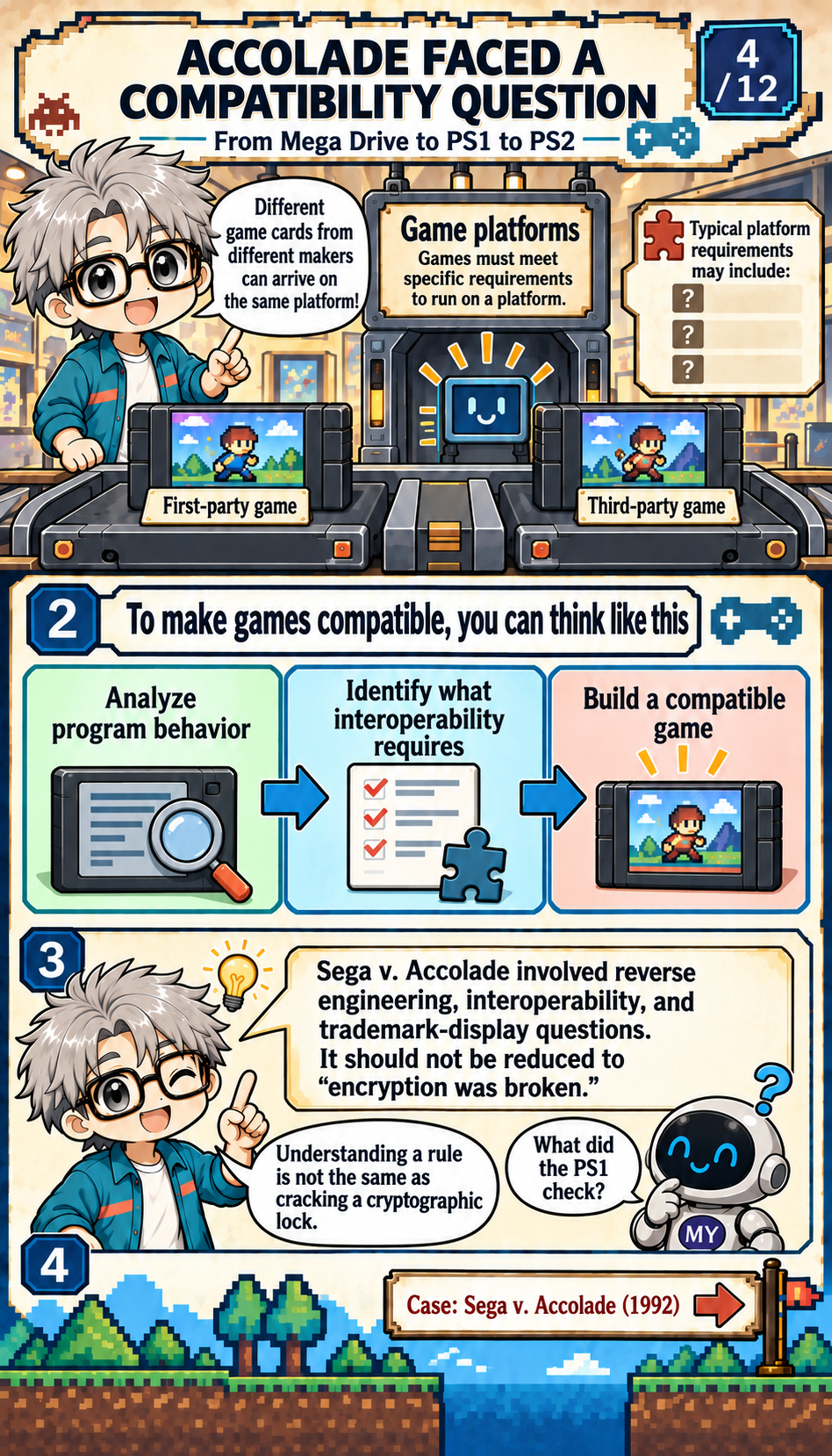
Accolade's story was about interoperability, not a cipher break
Accolade wanted to publish compatible games for Sega's platform. The dispute involved reverse engineering, interoperability, and trademark-display questions. The court record explains the context in which Accolade studied Sega software and the effects of the TMSS requirement. It is misleading to retell the episode as though Accolade had defeated a strong encryption algorithm. [1]
The classroom lesson is broader than the legal outcome: a platform can impose a compatibility condition, and an independent developer may investigate what software must do to interoperate. That investigation is conceptually different from recovering a secret cryptographic key or copying a physical authentication feature. [1]
When describing a historical 'crack,' name the boundary that changed. Here the more accurate frame is a compatibility and trademark gate, along with the legal treatment of reverse engineering—not a universal anti-piracy system being cryptographically broken. Precision keeps the history useful to both engineers and readers interested in preservation or interoperability. [1]
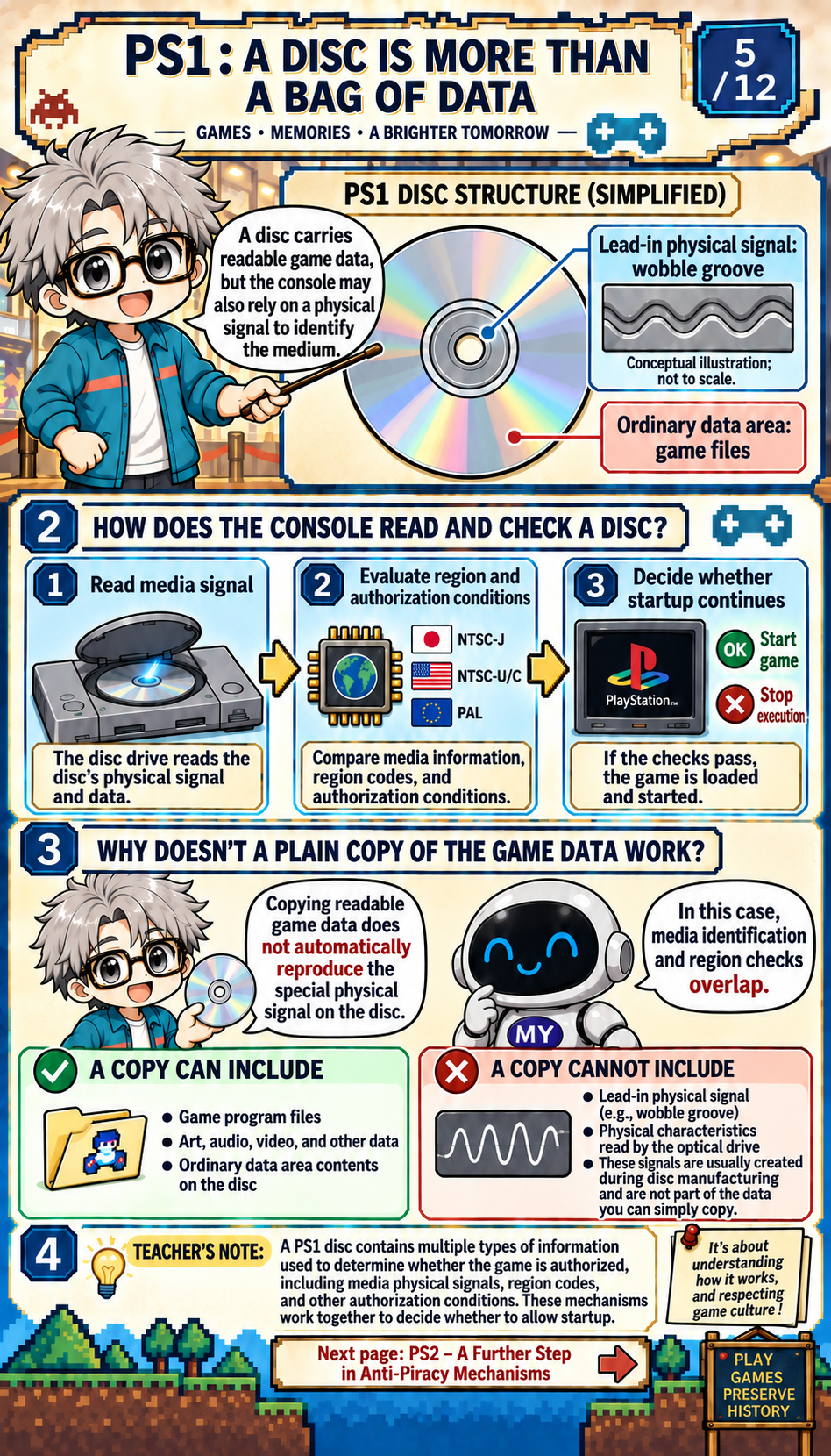
The PS1 disc carried more than readable game files
A PlayStation disc was not only a collection of ordinary data sectors. Historical technical research describes a physical wobble signal in the lead-in area, alongside region-related information. Sony's developer note separately documents copyright and piracy-protection checks; it is evidence that such checks existed, not a description of the wobble mechanism. [2][3]
This helps explain why copying files that a computer can read does not necessarily reproduce every property the console checks. A digital copy of game data and a physical characteristic of the manufactured medium are different kinds of evidence. For this historical design, media recognition and region enforcement were related rather than entirely separate. [2]
The details varied across media and platform revisions, so the safe teaching point is not that one waveform explains every PlayStation check. It is that a device can inspect both content and properties of its physical carrier—and a copy that preserves one may fail to reproduce the other. [2]
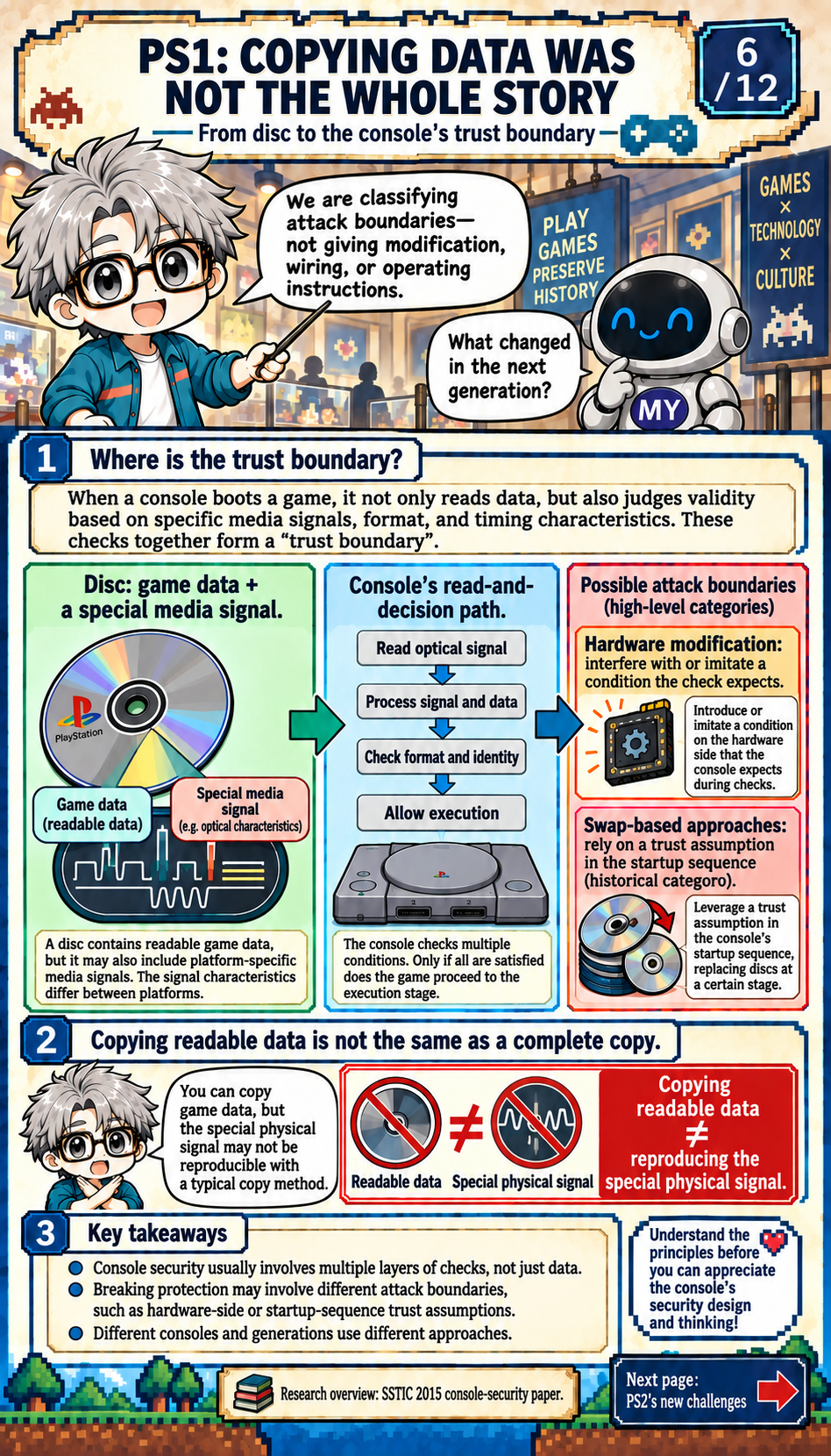
PS1 bypasses crossed the media trust boundary
Once the console relied on a particular media signal and startup behavior, later circumvention attempts targeted that decision path rather than merely copying ordinary files. Historical accounts describe broad categories such as hardware modifications that interfered with or imitated an expected check, as well as approaches that relied on assumptions in the startup sequence. [2]
We do not need wiring diagrams or timed instructions to learn from the example. At the architecture level, ask where the trust boundary sits: between the optical medium and the drive, between the drive and the console's decision logic, or inside the startup state machine. Changing what a checker observes is different from proving the checker’s cryptography unsound. [2]
This distinction is useful beyond games. A sensor can report a misleading value, a parser can make an unsafe decision, or a policy can trust a signal that an attacker can imitate. Security review asks whether the evidence is authentic, whether the path delivering it is protected, and whether the system fails safely when evidence is missing. [2]
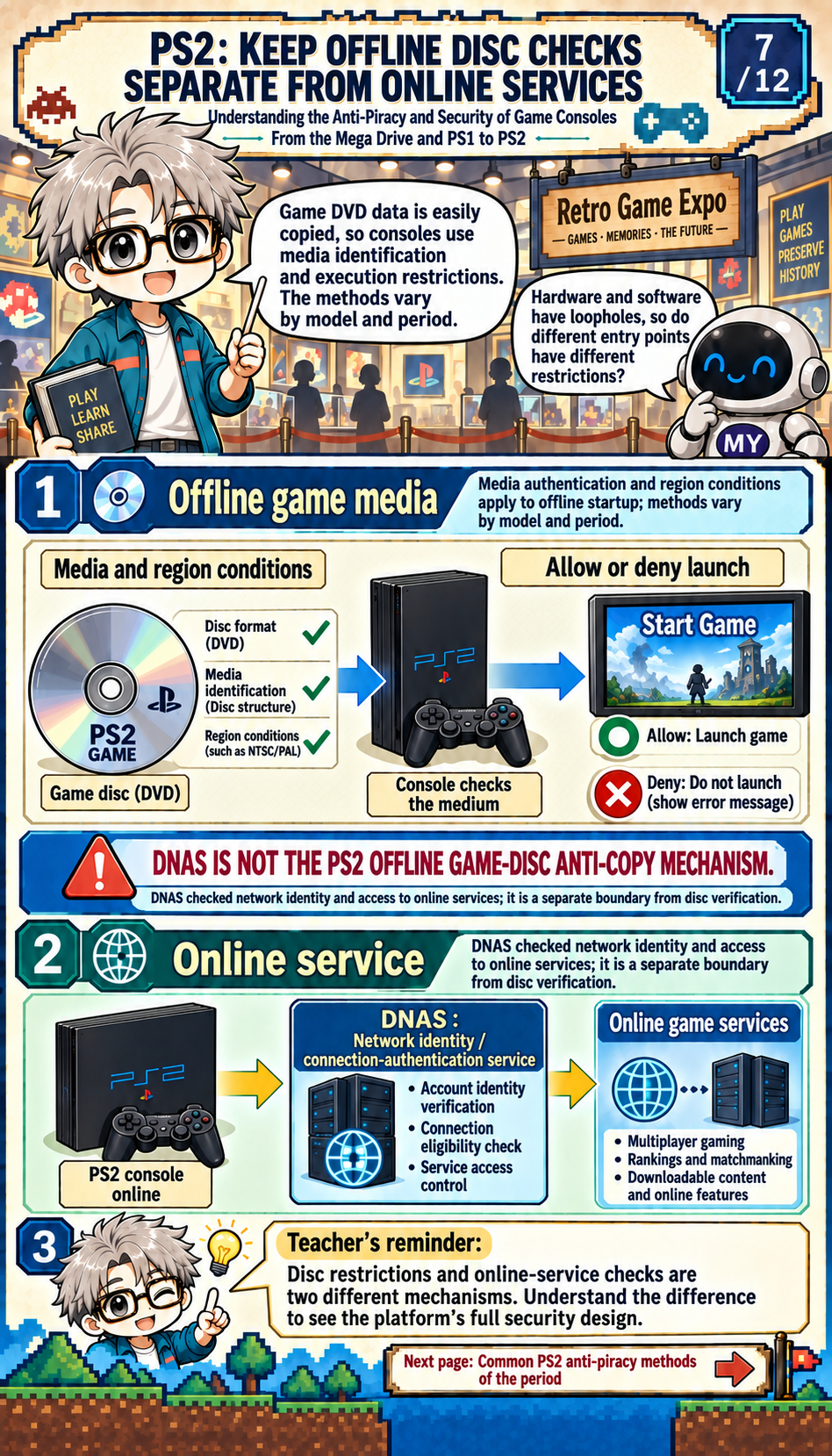
PS2 had offline media checks and online services
The PS2 moved into an era when DVD data was easier to duplicate than older cartridge media. Its game-start path used media and region conditions, with implementation details varying across models and periods. The basic question remained familiar: does the medium satisfy the console's rules for entering the game execution path? [4]
Online play introduced another boundary. Sony's DNAS—Dynamic Network Authentication System—was a network identity and service-authentication system. It dealt with access to online services, not the same offline question as whether a game disc passed a local startup check. Conflating DNAS with disc anti-copy obscures both mechanisms. [5]
A console can pass one check and fail another. A disc might be accepted locally while an online service denies an account or connection; conversely, an online identity check does not establish that every executable on a disc is safe. Separating boundaries helps us reason about what each control can and cannot protect. [5]
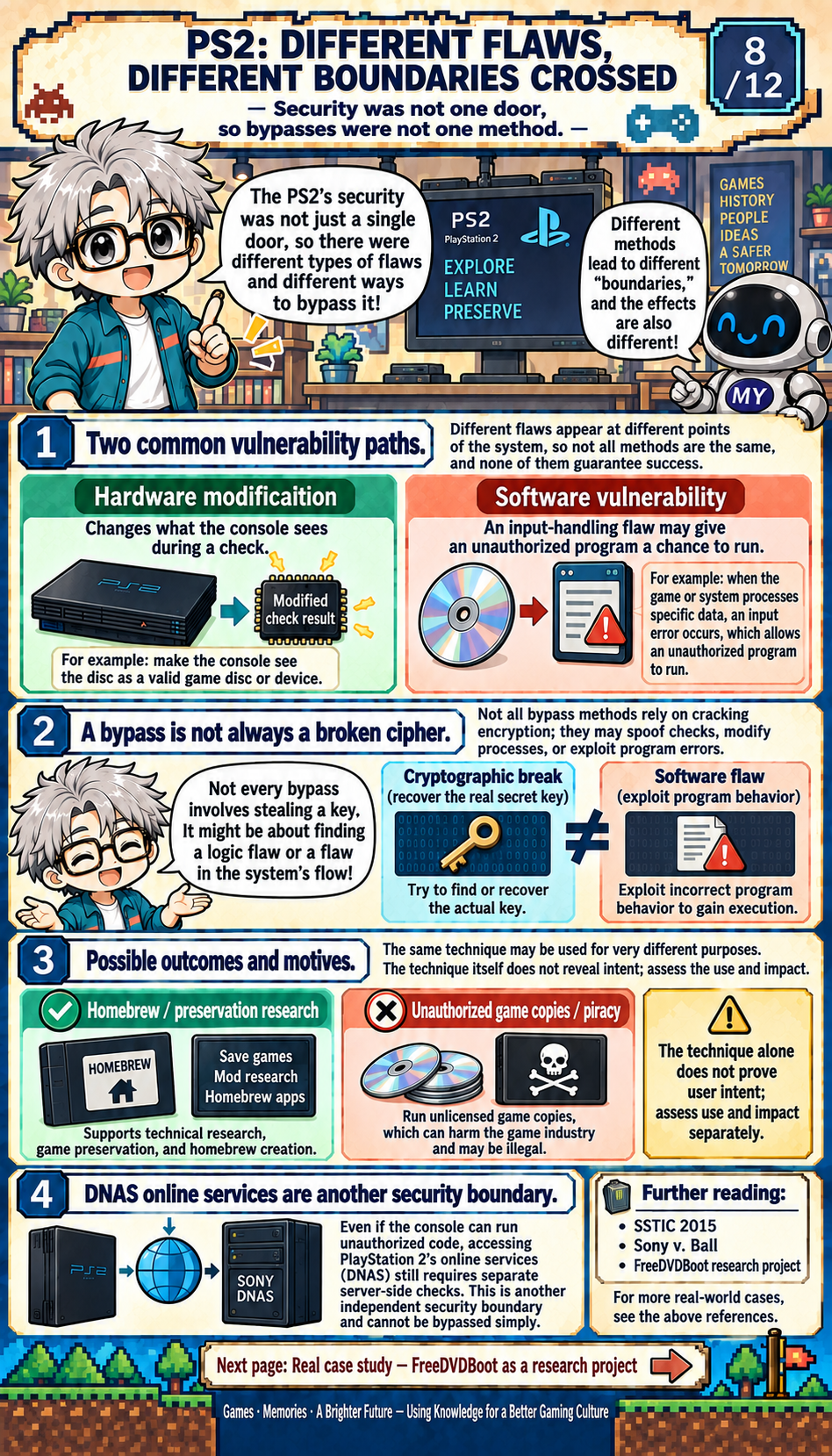
PS2 bypasses did not all break encryption
Historical PS2 circumvention included hardware modification categories and software paths that took advantage of bugs in how data or programs were handled. Later research such as FreeDVDBoot documents a software vulnerability affecting particular circumstances. These are not all the same method, and none should be casually summarized as 'the encryption was cracked.' [7]
A cryptographic break means defeating a cryptographic construction or recovering a secret under its intended model. A parser or state-machine bug means the program made an unsafe decision when processing input or moving through a sequence. A hardware modification may change what a check observes. Different causes need different mitigations. [2][6]
The outcomes also differ. Some work enabled homebrew, research, or preservation; other uses enabled unauthorized copies or cheating. Those categories can overlap in a technical ecosystem, but an exploit's existence does not tell us which purpose motivated a particular person. Good reporting separates the discovered capability from later uses and their consequences. [2][6]
Compare the checked object, attack entry point, and impact
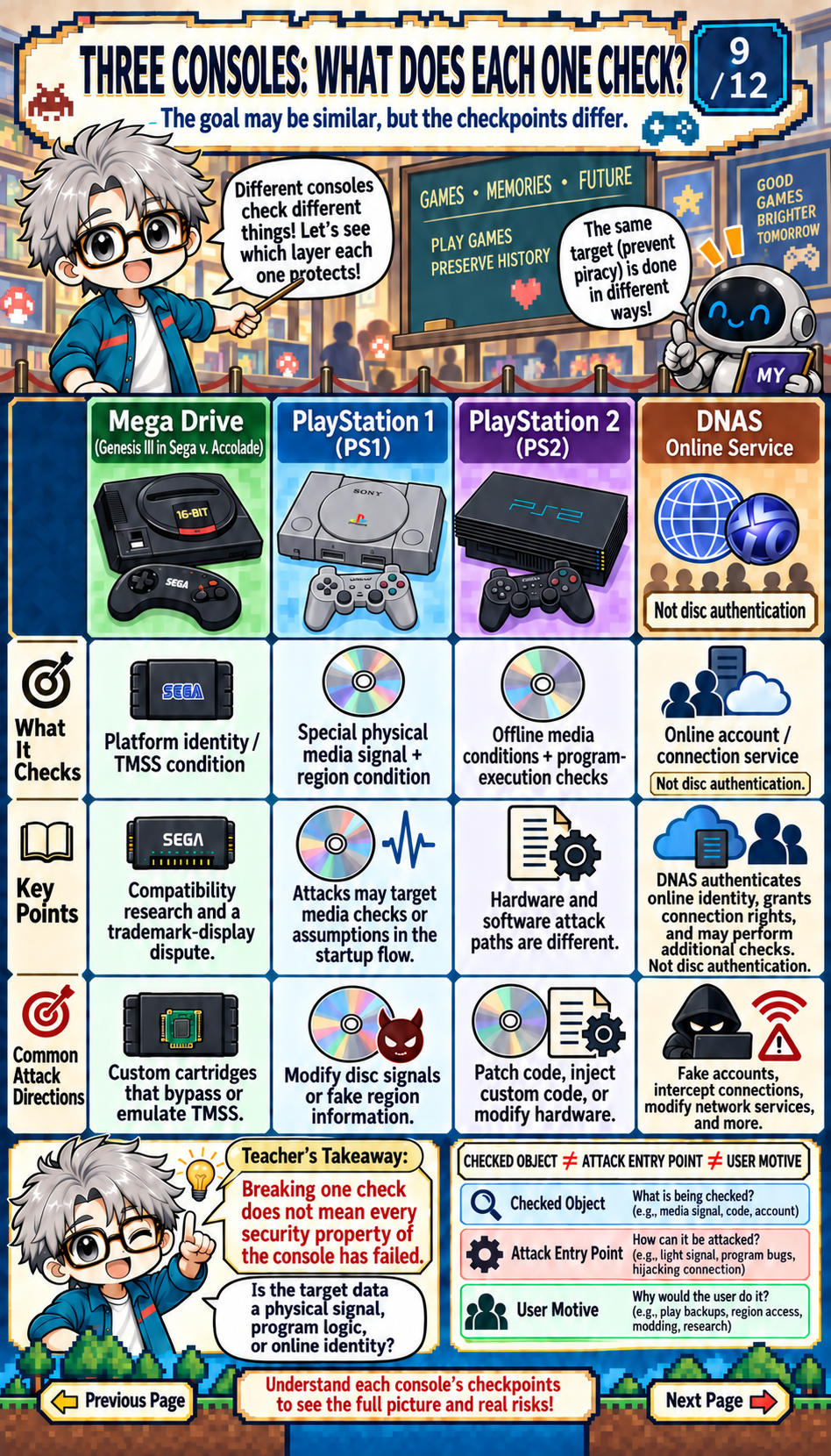
Across these systems, the checked object changed: the Genesis III discussed in Sega v. Accolade, a physical disc signal and region condition on PS1, then layered offline media and software-execution conditions on PS2. DNAS belongs in a separate online-service column. Similar user-visible symptoms do not imply identical mechanisms. [1][2][4][5]
A second axis is the attack entry point. A person may modify hardware, supply a crafted program or medium, exploit a software bug, or attack an online account. A third axis is impact: unauthorized copies, interoperability, preservation, cheating, account compromise, or malicious code execution. Keeping these axes separate prevents a misleading one-word label from replacing analysis.
The main inference is modest but important: defeating one check does not prove that the entire console is insecure. It shows that one policy boundary, in a particular configuration and threat model, did not stop a particular path. Engineers then need to test adjacent controls and the system's behavior after that boundary is crossed.
Why would someone want a different startup path?
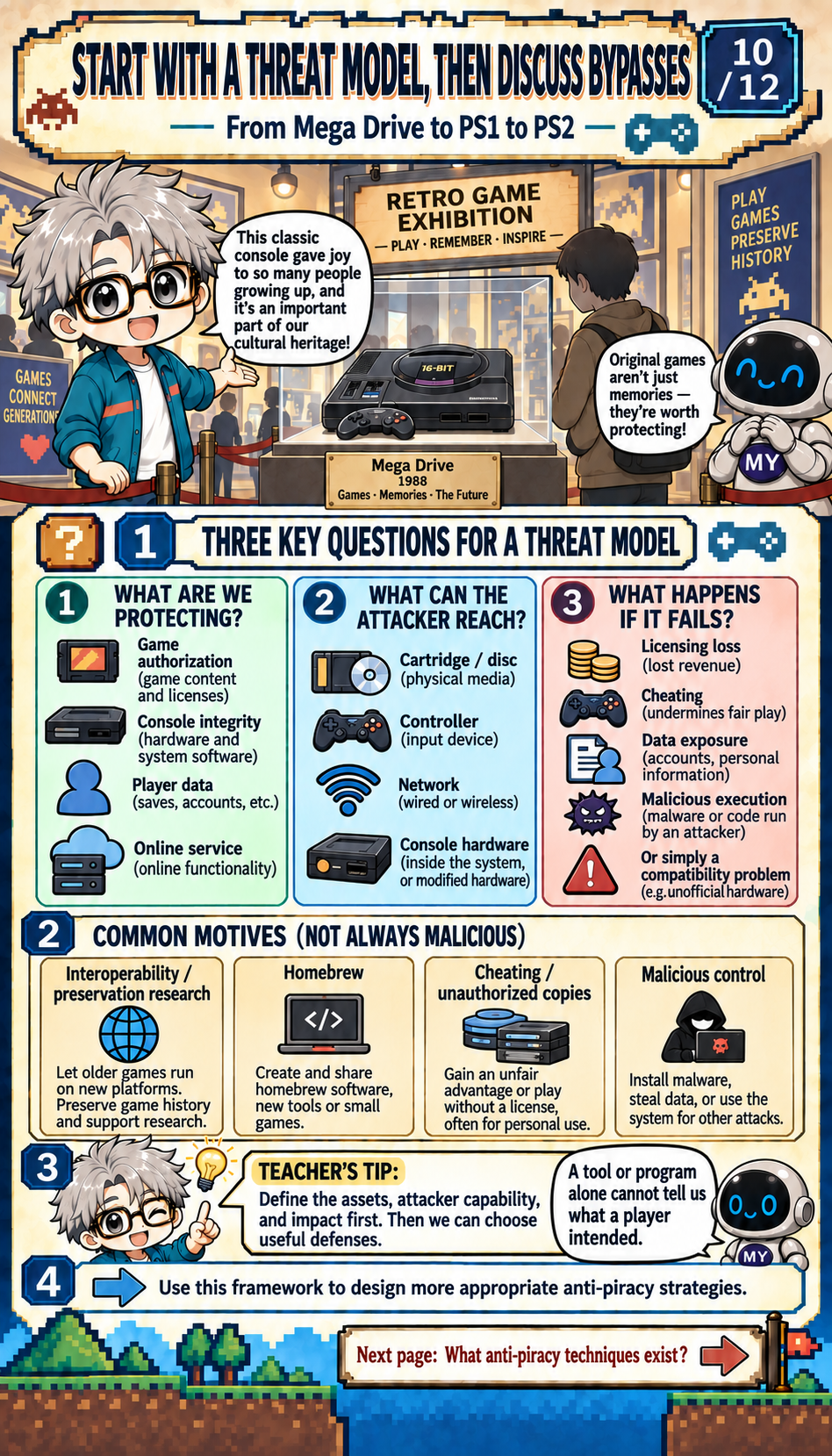
Start with a museum visitor who wants to run an old game on a newer system. Their goal may be preservation or interoperability. A developer who writes homebrew wants a platform to run code they control. Another user may seek an unfair advantage or distribute games without authorization. An attacker may want to install malware, steal saved credentials, or compromise an online service.
The threat model names the assets, attacker access, capabilities, and likely impact. Can the attacker touch only removable media, or can they open the console? Is the goal to run one program locally, alter a multiplayer match, or persist across reboots? Does the system contain valuable account or payment data? Those questions determine whether media checks, code signing, sandboxing, network controls, or recovery are relevant.
This is why we should not teach 'hackers' as one character with one motive. Security research, interoperability, preservation, piracy, cheating, and malicious intrusion can involve overlapping techniques but different authorization, intent, and harm. A responsible case study explains the capability and impact without assuming a motive the evidence does not establish. [2]
Anti-copy and Secure Boot answer different questions
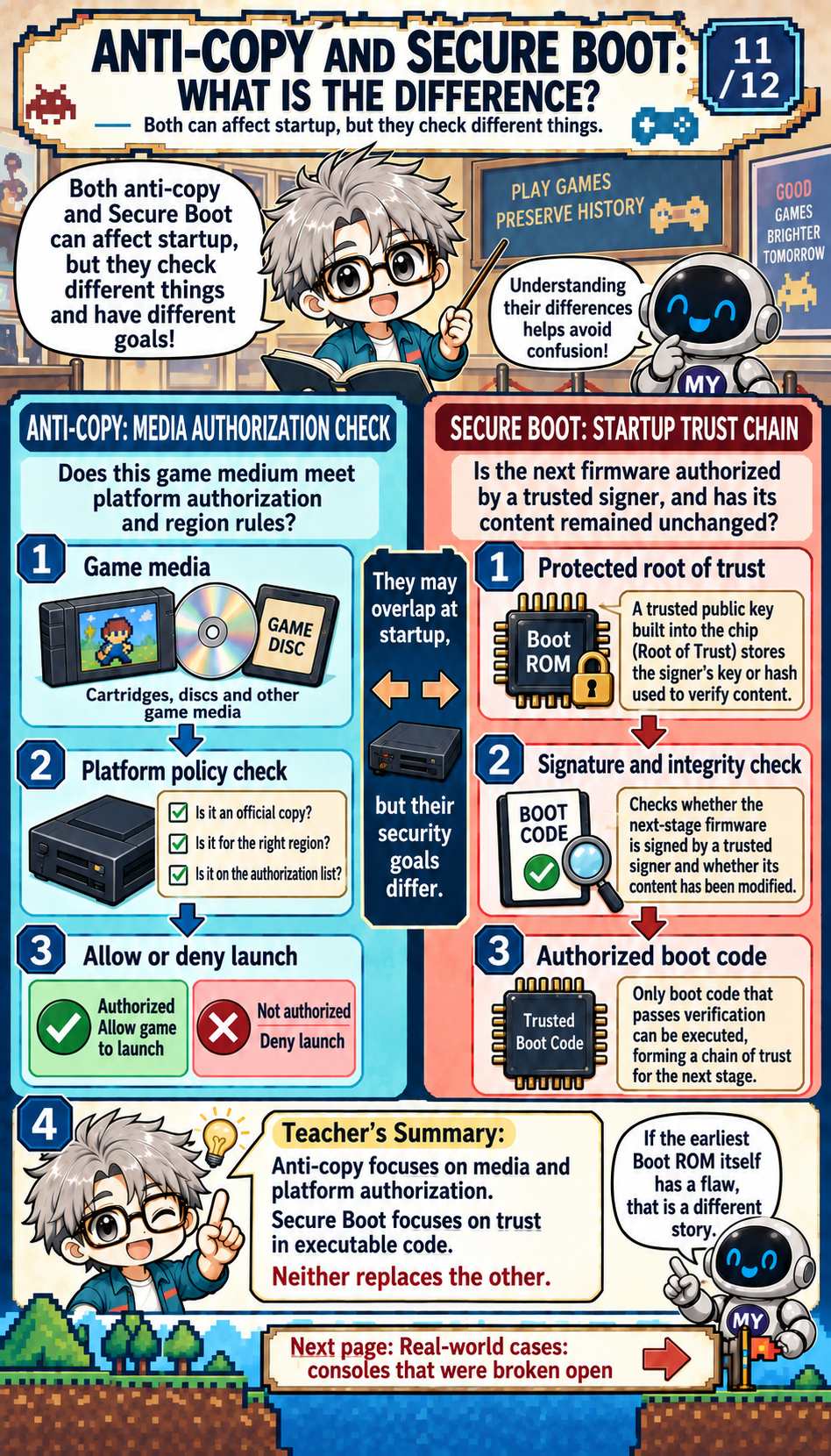
A media authorization check asks whether a game medium meets the platform's rules—perhaps a regional policy or a medium-specific condition. Secure Boot asks whether the next program in the startup chain is authorized by a trust anchor and has not been altered under the verification policy. Both can affect whether a device reaches gameplay, but the objects and security goals differ.
That means one cannot replace the other. A disc authorization check does not necessarily establish the integrity of every later program. Secure Boot can establish a controlled chain of executable code, but it does not by itself decide whether a game license is valid, whether an online account may connect, or whether already-authorized software is free of vulnerabilities. [8]
The shared design lesson is to be explicit about the claim each check supports. Identify what is measured or authenticated, where the trusted reference comes from, what an attacker can influence, and what happens after a failure. If the earliest Boot ROM contains a flaw, the trust-chain problem begins even earlier; that is the subject of a separate secure-boot case study. [8]
Return to the exhibition with a design checklist
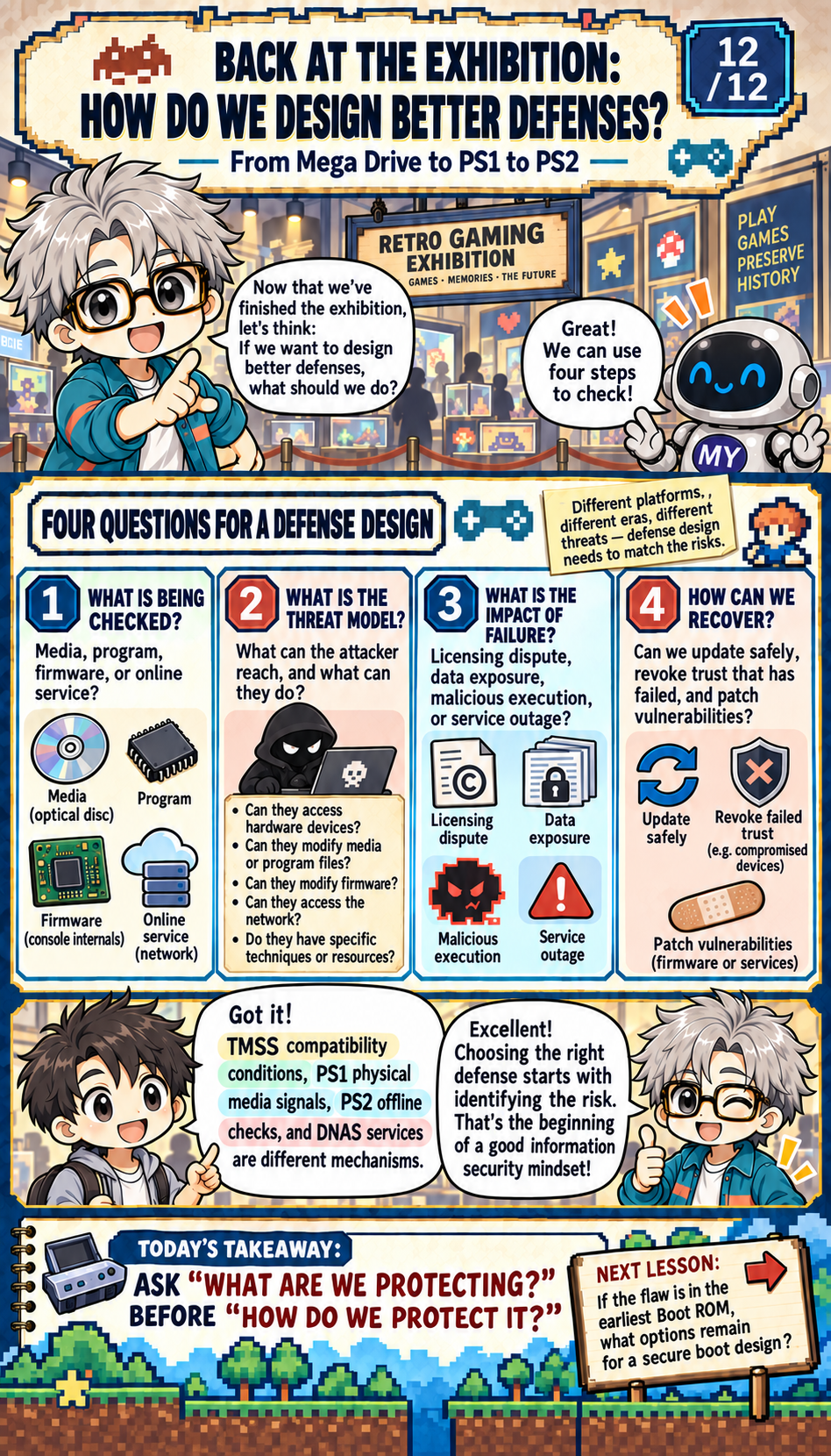
We can now answer the visitor without treating Mega Drive, PS1, and PS2 as one story. The TMSS issue concerns the Genesis III discussed in Sega v. Accolade and its compatibility-related identification condition; the opinion does not describe every Mega Drive or Genesis model. The PS1 example involved physical media signals and region behavior. PS2 combined offline media checks with program-execution paths, while DNAS served online authentication needs. [1][2][5]
When designing a defense, ask four questions: what is being checked—media, program, firmware, or service? What can the attacker reach and do? What is the consequence if the check fails? How can the product update, revoke trust, recover, and communicate the result safely? A defense is only meaningful in relation to the threat model it was built to address.
The next step is to move from removable media to the first code that runs inside a device. If the vulnerability is in the earliest Boot ROM, later software checks may never get a chance to run. Understanding that problem leads us from console copy protection to hardware roots of trust and Secure Boot. [8]
Five distinctions to keep
- A blocked launch is a symptom; identify whether the check concerns platform identity, physical media, executable code, or an online service.
- TMSS in the Sega v. Accolade case concerns the Genesis III discussed in the opinion; do not generalize it to every Mega Drive or Genesis model.
- Copying readable disc data is not necessarily reproducing a medium-specific physical signal.
- PS2 hardware modifications, software flaws, and DNAS online authentication cross different boundaries; a bypass is not automatically a cryptographic break.
- Anti-copy policy and Secure Boot protect different claims and should be designed against an explicit threat model.
Next, follow the trust chain to the earliest code that runs: what changes when a flaw sits in Boot ROM?
References
- Sega Enterprises Ltd. v. Accolade, Inc., 977 F.2d 1510 (9th Cir. 1992): Primary court opinion concerning Genesis III, TMSS, reverse engineering, interoperability, and trademark display.
- Renard and Benadjila, Strategies of Defense and Attack: the Case of Game Consoles (SSTIC 2015): Historical technical overview of console defenses and attack categories, including optical-media checks.
- Sony Computer Entertainment, PlayStation Technical Note: Checking PlayStation CD-ROMs: Contemporaneous platform technical documentation related to disc checking.
- Copetti, PlayStation 2 Architecture: Anti-Piracy and Homebrew: Secondary technical analysis of PS2 media checks, model differences, and homebrew context.
- Sony Computer Entertainment, Dynamic Network Authentication System for PlayStation 2 (2001): Official announcement describing DNAS as a network authentication service; distinct from offline disc verification.
- Sony Computer Entertainment Europe Ltd. v. Ball, [2004] EWHC 1738 (Ch): Court record concerning PS2 circumvention devices and their asserted uses.
- CTurt, FreeDVDBoot research project: Original research project documenting a PS2 software vulnerability; cited for historical context, not as an operational guide.
- NIST SP 800-193, Platform Firmware Resiliency Guidelines: Guidance on protecting platform firmware, detecting unauthorized changes, and recovering securely.
Experiment: marker, media evidence and code signature
Keep the first four bytes and change only the payload. The marker still matches, but ECDSA rejects the modified program. Switch checks, then change the region and online-service conditions to see which gate affects launch.
This comparison uses a public ACAD marker and custom data. SHA-256 and ECDSA are computed. Physical-media evidence, region and service entitlement are supplied conditions. It does not implement TMSS, PS1 wobble, PS2 or DNAS, or establish licensing, copyright status or bug-free code.
Learning guide
How Trust Is Built Inside a Chip
Open the course outline → · Progress counts published lessons only
Prerequisites
What I learned
- Identify what a console checks before starting a game
- Separate media checks from online identity and software trust
- Build a threat model from assets, access, and impact